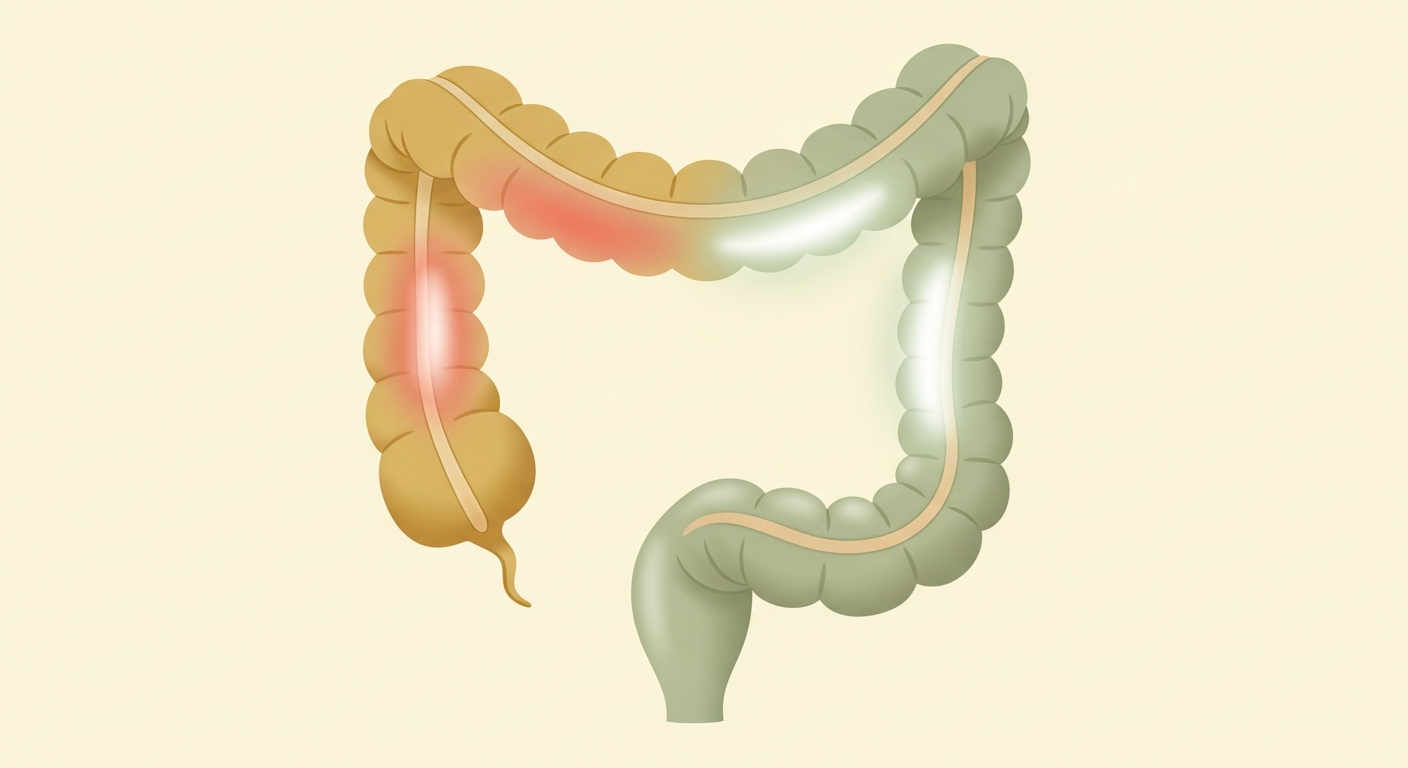
Inflammatory bowel disease (IBD) — the umbrella term for ulcerative colitis and Crohn's disease — affects roughly 3 million Americans and is one of the most active research areas in gastroenterology. Patients living with IBD often ask me a version of the same question: "My gut microbiome is disrupted. If you replace it with a healthy one, won't that fix my disease?"
It's a reasonable question, and the science behind it is real. But the honest answer is more nuanced than either "yes" or "no." This article is a pillar guide to where fecal microbiota transplant (FMT) sits in IBD treatment in 2026 — what the evidence shows, what it doesn't show, and how I think about it as a naturopathic medical doctor practicing in California.
Why the Microbiome Matters in IBD
Both ulcerative colitis and Crohn's disease are characterized by chronic inflammation of the digestive tract, but they are fundamentally diseases of an immune system that has lost tolerance for the trillions of microbes living inside us. Decades of research have established that people with IBD consistently show:
- Reduced overall microbial diversity
- Depletion of butyrate-producing bacteria such as Faecalibacterium prausnitzii and Roseburia
- Expansion of pro-inflammatory species, including certain strains of Escherichia coli
- Altered fungal and viral communities, not just bacterial ones
- A weakened intestinal mucus barrier and disrupted bile acid signaling
This pattern — known as dysbiosis — was the original rationale for testing FMT in IBD. If a sick microbiome contributes to inflammation, replacing it with a healthy donor microbiome should, in theory, restore balance and reduce disease activity. The reality has turned out to be both more interesting and more complicated than that simple model.
FMT for Ulcerative Colitis: The Strongest IBD Evidence
Of the two IBD conditions, ulcerative colitis (UC) has by far the more developed FMT literature. Four well-designed randomized controlled trials — Moayyedi (2015), Rossen (2015), Paramsothy (2017), and Costello (2019) — tested FMT in patients with active UC. Three of the four showed a statistically significant benefit over placebo for inducing clinical and endoscopic remission, with the most intensive protocols achieving remission rates around 27–32%, compared with roughly 8–9% on placebo.
Several patterns emerged from these trials that I find clinically important:
- Dose and frequency matter. Trials using more frequent infusions over a longer period generally outperformed single-administration protocols.
- Donor matters. Some donors consistently produced better outcomes than others — the so-called "super-donor" phenomenon — which suggests that not all microbiomes are equally therapeutic.
- Engraftment matters. Patients in whom donor bacteria actually colonized the gut did better than those in whom the donor signature faded quickly.
- FMT is an adjunct, not a replacement. Most trial participants stayed on their existing UC therapy. FMT was layered onto standard care, not substituted for it.
I covered these UC trials in detail — including the practical implications for patients — in FMT for Ulcerative Colitis: What the Research Actually Shows. If UC is your primary concern, that post is the next stop.
FMT for Crohn's Disease: A Different and Harder Story
Crohn's disease has been markedly more difficult to study and to treat with FMT, and the evidence base is correspondingly weaker. There are good reasons for this:
- Disease distribution. Crohn's can affect any part of the digestive tract from mouth to anus, often in a patchy, transmural pattern. UC, by contrast, is limited to the colon, which makes it a more accessible target for colonic FMT delivery.
- Disease heterogeneity. Two patients with "Crohn's disease" may have very different disease behavior — inflammatory, stricturing, or fistulizing — and the microbiome may play a different role in each.
- Structural complications. Strictures, fistulas, and prior bowel resections all complicate any therapy that depends on healthy mucosal contact and engraftment.
The trials that have been done in Crohn's are smaller and have produced mixed results. Some early-phase studies showed modest signals of clinical improvement in selected patients with mild-to-moderate disease, while larger and more rigorous trials have not consistently confirmed benefit. There is a real and active research effort to identify which Crohn's patients might respond, but at present FMT for Crohn's should be considered investigational.
I unpack the Crohn's-specific evidence in more depth in FMT for Crohn's Disease: What the Research Actually Shows. If Crohn's is your primary concern, please read that post before drawing conclusions about FMT.
The One Setting Where FMT Is Clearly Established
It's worth pausing to acknowledge what FMT actually is well-established for, because this matters for IBD patients too. The treatment has the strongest evidence — and the only widespread clinical use — for recurrent Clostridioides difficile (C. diff) infection, where it routinely achieves cure rates above 85% after standard antibiotics have failed. That is a different scale of evidence than what we have for IBD.
This matters because IBD patients are at elevated risk for C. diff infections, and a recurrent C. diff infection on top of underlying UC or Crohn's can be devastating. In that specific scenario — IBD patient with recurrent C. diff — FMT is one of the clearest indications in modern gastroenterology, and that is the most common reason an IBD patient ends up receiving it in routine practice today.
How I Think About FMT for IBD in 2026
When IBD patients ask me about FMT, I try to be straightforward about three things:
1. The biology is real.
The link between dysbiosis and IBD is one of the best-supported observations in modern gastroenterology, and microbiome-directed therapies are very likely to be part of how we treat IBD over the next decade. FMT is the bluntest form of that approach, and it is not the only one — defined consortia of bacteria, postbiotics, and engineered probiotics are all in active development.
2. The evidence is uneven.
For UC, FMT has crossed the threshold of "shown benefit in randomized trials" but has not crossed the threshold of "standard of care." Protocols, donors, dosing, and patient selection are still being worked out. For Crohn's, the evidence is weaker still and the picture is more cautious. For IBD-related recurrent C. diff, FMT is genuinely transformative.
3. FMT is an adjunct, not a replacement, for proven IBD therapies.
Modern IBD care — including 5-ASAs, biologics, and small-molecule therapies — is highly effective for many patients. FMT is not an alternative to that care. The patients who benefit most from a microbiome-focused approach are typically those whose conventional therapy is partially working but who are still symptomatic, those dealing with overlapping issues like recurrent C. diff or post-antibiotic dysbiosis, and those who want a comprehensive plan that addresses diet, stress, sleep, and the microbiome alongside their gastroenterology care.
Practical Considerations Before Pursuing FMT
If you have IBD and are considering FMT, here are the questions I would want you to think through:
- Where are you in your treatment journey? Have you fully optimized conventional therapy? Are you on the right biologic at the right dose?
- Is there a clear C. diff component? Recurrent C. diff dramatically changes the calculus and is the single best-established reason to pursue FMT.
- How is your disease behaving? Mild-to-moderate left-sided UC behaves very differently from extensive pancolitis or stricturing Crohn's, and the realistic expectations for FMT differ accordingly.
- What is your delivery preference? Capsules, retention enema, and colonoscopic delivery each have trade-offs that I cover in FMT Capsules vs. Enema vs. Colonoscopy.
- Who is your team? FMT for IBD should never be done in isolation from your gastroenterologist. Microbiome therapy is one piece of a larger care plan, not a stand-alone fix.
My Approach at Purety Family Medical Clinic
I practice naturopathic medicine in Santa Barbara and serve patients across California — see FMT in California for our service overview. I take a research-grounded view of FMT: I will tell you honestly when the evidence supports it for your situation, and I will tell you just as honestly when it doesn't. For most IBD patients, the right plan is a combination of optimized conventional care, targeted microbiome support (which may or may not include FMT), and a serious look at the dietary, lifestyle, and inflammatory factors that influence disease activity.
If you'd like to discuss whether FMT is worth considering as part of your IBD care, I'm happy to review your case and lay out the realistic options. Schedule a consultation and we'll talk through where the science actually stands for your specific situation.