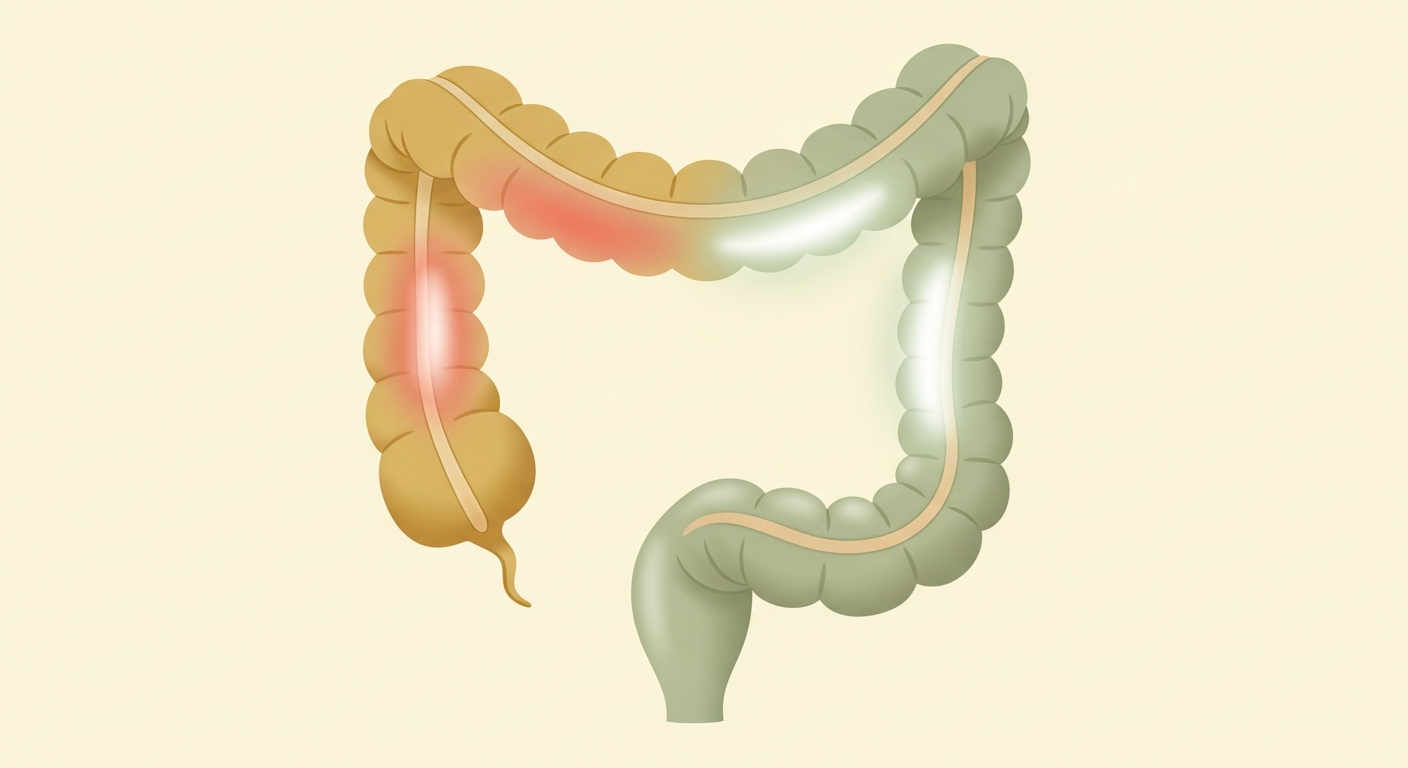
Crohn's disease is among the most complex and heterogeneous conditions in gastroenterology. Unlike ulcerative colitis, which is confined to the colon, Crohn's can affect any part of the gastrointestinal tract from mouth to anus, involves transmural (full-thickness) inflammation, and presents with a wide spectrum of severity and behavior — from mild inflammatory disease to stricturing and penetrating complications. For these reasons, Crohn's has been one of the more challenging frontiers for FMT research. But the science of the gut microbiome in Crohn's is advancing rapidly, and I think it's worth reviewing what we know and where the research is heading.
The Microbiome in Crohn's Disease
The evidence linking gut dysbiosis to Crohn's disease pathogenesis is extensive and well-replicated. Patients with Crohn's show some of the most profound microbiome alterations of any studied condition: reduced overall microbial diversity, marked depletion of Faecalibacterium prausnitzii (a key anti-inflammatory butyrate producer), increases in adherent-invasive Escherichia coli (AIEC) strains, and disrupted intestinal barrier function.
Critically, these microbiome changes are not simply a consequence of inflammation — several lines of evidence suggest they precede and contribute to disease onset. Studies of first-degree relatives of Crohn's patients who do not yet have disease show microbiome alterations intermediate between healthy controls and active Crohn's patients. This suggests that microbiome disruption is part of the causal chain, not merely a bystander effect.
The Crohn's and Colitis Foundation's Gut Microbiota in Inflammatory Bowel Disease (GEMS) study, one of the largest microbiome studies in IBD, confirmed that Crohn's patients have consistently lower microbial diversity and distinct compositional changes compared to both UC patients and healthy controls — pointing to the possibility that microbiome-directed therapies may need to be different for Crohn's than for UC.
FMT Research in Crohn's: Where We Are
The clinical evidence for FMT in Crohn's is earlier-stage than for C. diff or ulcerative colitis. Published trials are smaller, results have been more variable, and the heterogeneity of Crohn's disease itself makes it harder to study.
A 2015 pilot study by Vaughn et al., published in Inflammatory Bowel Diseases, examined FMT via colonoscopy in 9 patients with active Crohn's disease. At four weeks, clinical improvement was noted in 7 of 9 patients, with endoscopic improvement in several. While limited by small sample size and absence of a control group, this early signal prompted further investigation.
A 2019 randomized pilot trial published in the Journal of Crohn's and Colitis randomized 17 Crohn's patients to FMT or autologous placebo. While the study was powered for feasibility rather than efficacy, it demonstrated that FMT is safe in Crohn's patients and provided preliminary signals of benefit in a subset of participants.
A notable finding from multiple Crohn's FMT studies is that patients who had concurrent C. difficile infection or significant gut dysbiosis appeared to derive greater benefit than those with more typical Crohn's presentations. This suggests that FMT's effects in Crohn's may be most pronounced when there is a clear microbiome-level disturbance superimposed on the inflammatory process.
The Immune Complexity Challenge
One reason FMT results in Crohn's have been more variable than in UC relates to the immunological complexity of the disease. UC is driven primarily by a Th2-skewed immune response targeting the colonic mucosa — a relatively defined target. Crohn's involves a broader Th1/Th17 immune response, can affect multiple GI segments, and is more closely tied to genetic variants in innate immune recognition (particularly NOD2 mutations).
This means that microbiome restoration alone may be insufficient to control Crohn's inflammation in many patients, particularly those with severe or complicated disease. The most promising framework emerging from the research views FMT not as a standalone therapy for Crohn's, but as a potential adjunct to existing treatments — something that could complement biologics or immunomodulators by addressing the microbial component of disease while medication addresses the immune component.
Concurrent C. diff in Crohn's Patients
One established and clinically important overlap is the high rate of concurrent C. difficile infection in IBD patients. Crohn's patients are significantly more susceptible to C. diff infection than the general population, due to altered gut microbiome composition, frequent antibiotic exposure, and immune dysfunction. C. diff infection can trigger severe IBD flares and significantly complicate management.
In this specific context — Crohn's patients with confirmed recurrent or refractory C. difficile — FMT has a well-established evidence base for the C. diff indication, and case series and cohort studies have documented that IBD patients receiving FMT for C. diff often also experience improvements in their IBD disease activity. This "dual benefit" has been reported in multiple studies and represents a clinically meaningful scenario.
What to Watch For
Several larger, well-designed trials examining FMT in Crohn's disease are currently underway. Key variables being studied include the optimal delivery route (colonoscopy appears superior to enema for reaching proximal disease), the frequency and duration of treatment, donor selection criteria, and patient subgroup stratification (for example, by disease location, behavior, and genetic profile).
The next five years of research will substantially clarify whether and for whom microbiome restoration strategies play a meaningful role in Crohn's management. I follow this literature closely and am glad to discuss the current state of evidence with patients who are curious about where the science is heading.
If you have Crohn's disease and want to understand more about the microbiome science underlying your condition — or explore whether any microbiome-directed approaches might be relevant to your situation — I'd welcome a conversation. Crohn's patients who also have recurrent C. difficile may be particularly good candidates for FMT. Schedule a consultation and we can review what the research currently shows in the context of your specific case.
For related reading, see our companion reviews of FMT for ulcerative colitis (where the RCT evidence is more developed than in Crohn's), FMT for IBS, and FMT for SIBO.
About the Author
Dr. Jonathan Birch, NMD
Medical Director at Purety Family Medical Clinic and one of the most experienced Fecal Microbiota Transplant clinicians in the United States — over 1,000 FMT procedures since 2014.
To learn more about our protocols, donor screening, and delivery methods, visit the main FMT services page. California patients can also see FMT availability across California.